Inside Our Anaheim Treatment Room: What the Patient Experience Looks Like
What the patient experience looks like inside our Anaheim treatment room — and why a coordinated outpatient setting, deliberately unlike a hospital department, reduces friction for patients beginning a course of TMS for treatment-resistant depression.
Article body
The clinic does not look like a hospital, and that is a deliberate clinical choice. Patients beginning a course of transcranial magnetic stimulation are most often patients living with treatment-resistant depression — a population for whom the sensory environment of a hospital outpatient department (fluorescent lighting, gowns, procedure carts, the visual cues of acute medicine) tends to add friction at the exact moment care is meant to begin. Healing TMS Clinic is structured instead as a coordinated outpatient psychiatric practice: private offices for clinical evaluations and medication management, a treatment room sized for one chair and one coil, and a reception area that reads more residential than medical. This article is a literal walkthrough — what a patient in Anaheim actually encounters from the front door to the chair to the drive home.
The space, from the front door
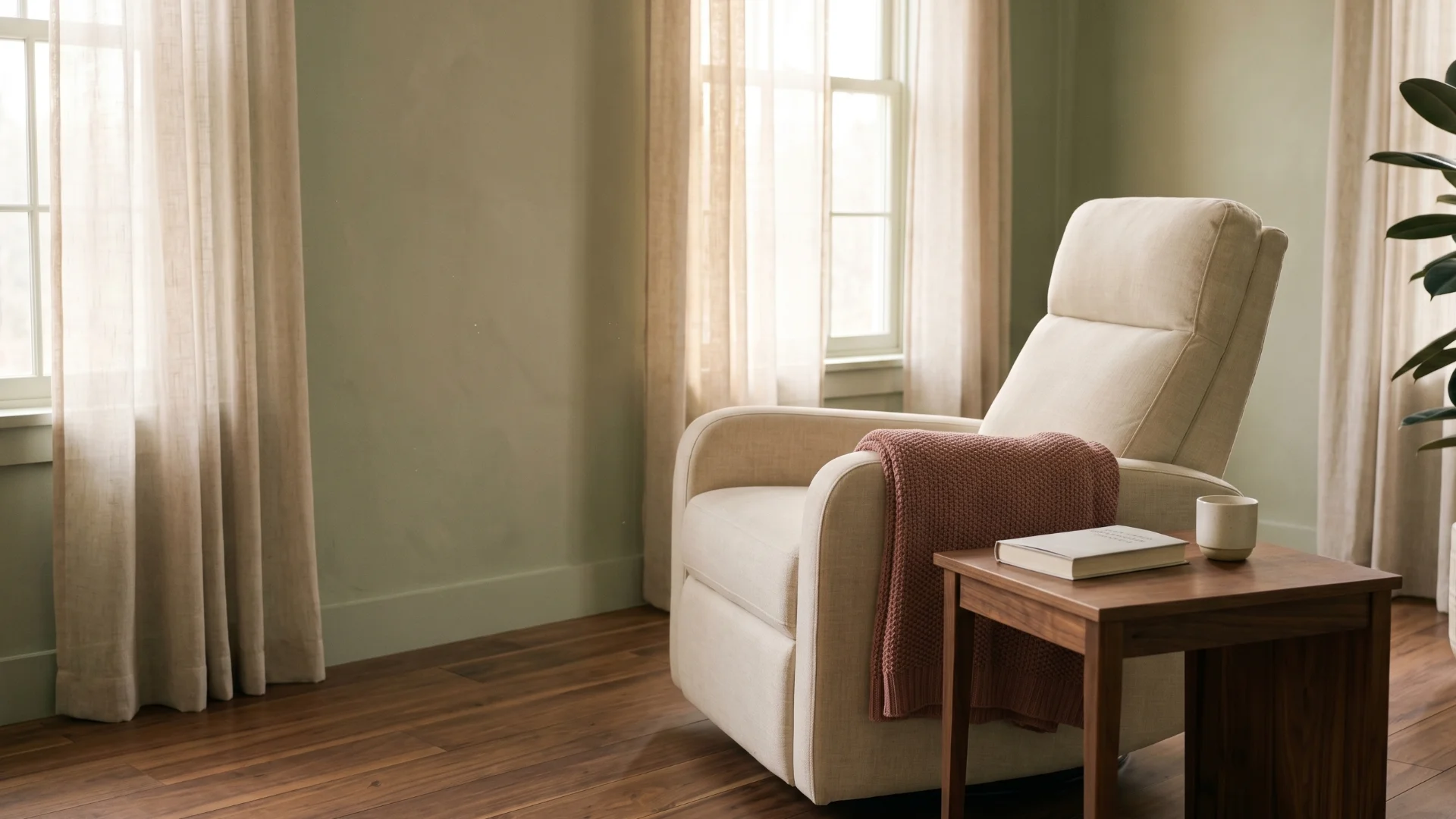
The reception area is a small, daylit room with upholstered seating, a side table, and plants — a rubber plant in one corner, a sage trailing vine on a shelf. Walls are sage; floors are walnut. Large windows let natural light in through sheer linen panels. There is no triage desk, no plexiglass partition, no intake clipboard wedged into a wall pocket. Check-in is handled in person by the same coordinator the patient corresponded with by phone or email, which means the first face a patient sees on session day is usually a familiar one.
The interior register is intentional. The visual vocabulary — sage, cream, walnut, dusty rose — is closer to a thoughtfully designed psychiatry office than to a clinical procedure suite. Patients with depression frequently describe a low-grade dread of medical settings; reducing that dread is part of the treatment experience, not a cosmetic afterthought.
The treatment room
The treatment room itself is a single private room with one chair, soft window light, and an adjustable arm that positions the treatment coil at the patient's head. The chair is a cream-linen recliner — comfortable enough to sit in for a 20-to-40-minute session, with a headrest sized for the coil to sit cleanly against the scalp at the prescribed angle. The room is quiet. There is no procedure cart, no IV pole, no monitor stack. The treatment equipment itself stays largely out of the patient's line of sight; only the arm and coil reach into the visual field.
Patients are encouraged to bring whatever helps them settle into the session — headphones, a podcast queue, an audiobook, a paperback. Many bring the same item to every session and develop a small ritual around it. There is no gown change. There is no IV. The session is delivered awake and unsedated.1
What the patient hears
The most frequently asked sensory question, before the first session, is about the sound. The treatment coil produces a sharp, mechanical clicking — one click per magnetic pulse — and during the active "trains" of a standard 10 Hz session, the clicks come in rapid bursts of roughly four seconds, separated by quiet rest intervals of roughly twenty-six seconds. The pattern is rhythmic and predictable.
Sound at the coil approaches 100 dB during active pulses, which is why foam earplugs are required, not optional, and are placed before the first pulse is delivered.1 With ear protection in place, the clicking is clearly audible but not painful. Patients listening to audio through over-ear headphones layered on top of the earplugs report that the click recedes into the background within the first one or two sessions.
There is nothing else to hear from the device itself — no alarm tones, no continuous mechanical hum. The room is otherwise quiet.
What the patient feels
The pulse is delivered through the coil resting against the scalp. The sensation, at the surface, is a brief tap or knock at the treatment site, repeated with each pulse. Patients describe it variously — a woodpecker tap, a finger flick, a light knock — and the descriptions converge on something rhythmic, localized to the scalp, and unmistakably mechanical rather than electrical.
Because the standard depression target sits near nerves that supply the forehead and jaw, some patients also feel a small twitch of the cheek, temple, or jaw with each pulse. This is normal, not painful, and stops the instant the train stops. Most patients describe the scalp sensation as most noticeable during the first two or three sessions; the scalp accommodates quickly and tolerability improves through the first treatment week.
Nothing is felt inside the head. The magnetic field stimulates a focal region of cortex, but the patient experiences no internal pressure, heat, light, or movement beyond what is felt at the scalp surface.
The safety profile of the in-chair experience is well-characterized. Under contemporary safety guidelines, seizure — the most clinically significant rare adverse event — is estimated at fewer than 1 per 60,000 sessions in pooled data with figure-8 coils and standard protocols.23
The non-clinical interactions
A session is structured around three brief human interactions, none of which has the texture of a hospital procedure:
- Check-in at reception with a coordinator the patient already knows by name. Insurance and scheduling questions are handled here, not at the chair.
- A short check-in with the clinical team before the session begins — a tolerability check, a question about any new headaches or sleep changes since the last session, a confirmation that the previous day's session went as expected.
- Settling into the chair, where the coil is positioned, earplugs are placed, and the patient signals readiness before the first train.
There is no gown, no IV, no pre-procedure fast, no monitoring lead placement, no hospital-style identification protocol at the chair. After the session, patients stand up, retrieve their belongings, and walk out through the same reception area they came in through. Most drive themselves to and from sessions; TMS does not affect alertness or cognition, and no driver is required.
The wider clinic
The treatment room is one part of a coordinated outpatient psychiatric practice. The same building houses private offices for clinical evaluations, medication management visits, and follow-up care. The psychiatrist who evaluates candidacy and signs the letter of medical necessity for insurance is the same psychiatrist who oversees the course of treatment and any concurrent medication adjustments. The coordinator who handled the prior-authorization workup is the same coordinator who greets the patient at the door. The clinical record is one record.
This matters for the in-chair experience in a small but practical way: by the time a patient arrives for a first session, the staff already know the case. There is no re-explaining the diagnosis, the medication history, or the reason for referral. The session begins where the evaluation left off.
The location
The clinic is in Anaheim, a short drive from most of north Orange County and within reach of the broader 30-mile radius the practice serves. The location is accessible from the 91, the 5, and the 57 freeway corridor, with on-site parking. Most patients drive themselves; sessions are scheduled into normal weekday slots so that a 30-to-45-minute appointment fits around work or school without requiring a half-day off.
Healing TMS Clinic is a coordinated outpatient psychiatric practice, not a hospital outpatient department. The distinction is meaningful for scheduling (no hospital intake routing), for billing (a single practice, not a facility-plus-professional split), and for the texture of the day itself. Patients are seen by the same small team, in the same small space, across the full course of treatment.
Key takeaways
- The treatment room is a single private room with one recliner, one adjustable coil arm, and soft window light — not a procedure suite.
- The clicking sound of the coil is the most-asked-about sensory detail; foam earplugs are required and make it tolerable. Audio through over-ear headphones is welcome.
- The scalp sensation is a localized, rhythmic tap; small facial-muscle twitches are normal. Tolerability improves within the first two or three sessions.
- Sessions are delivered awake and unsedated. Patients drive themselves to and from treatment.
- The clinic is structured as a coordinated outpatient psychiatric practice in Anaheim, with the same providers across evaluation, TMS, and follow-up care.
A note for patients in Anaheim and Orange County
Patients across Anaheim, Orange County, and the broader 30-mile radius considering a course of TMS therapy are welcome to begin with a clinical consultation. Coverage questions are usually the first practical hurdle, and our team handles the insurance verification process directly — most major commercial payers and Medicare are accepted. If a quick conversation would be useful before scheduling — to ask about the room, the schedule, the sound, anything at all — the clinic is reachable through the contact page.
Sources / Further reading
Perera T, George MS, Grammer G, Janicak PG, Pascual-Leone A, Wirecki TS. The Clinical TMS Society Consensus Review and Treatment Recommendations for TMS Therapy for Major Depressive Disorder. Brain Stimulation. 2016;9(3):336–346. ↩ ↩
Lerner AJ, Wassermann EM, Tamir DI. Seizures from transcranial magnetic stimulation 2012–2016: results of a survey of active laboratories and clinics. Clin Neurophysiol. 2019;130(8):1409–1416. ↩
Rossi S, Antal A, Bestmann S, et al. Safety and recommendations for TMS use in healthy subjects and patient populations, with updates on training, ethical and regulatory issues: Expert Guidelines. Clin Neurophysiol. 2021;132(1):269–306. ↩