Deep TMS (H-Coil) vs Figure-8 Coil: When Does Coil Geometry Matter?
Patients and referring clinicians frequently ask whether a "deep" TMS coil is better than a "standard" one.
Article body
Patients and referring clinicians frequently ask whether a "deep" TMS coil is better than a "standard" one. The answer is more nuanced than promotional framing suggests: coil geometry changes the shape and depth of the induced electric field, but for major depression both the H-coil and the figure-8 coil produce clinically meaningful, FDA-cleared antidepressant effects — and coil choice is only one of several parameters that determine outcome. This article reviews what the biophysical modeling and the multicenter trials actually demonstrate, and where geometry genuinely changes the clinical calculus.
Transcranial Magnetic Stimulation (TMS) delivers focused magnetic pulses through the scalp to induce an electric field in underlying cortex. The coil is the antenna that shapes that field, so its winding geometry is a first-order determinant of where and how deep neurons are stimulated.1
Two coil families, two field profiles
The figure-8 coil: focal and shallow
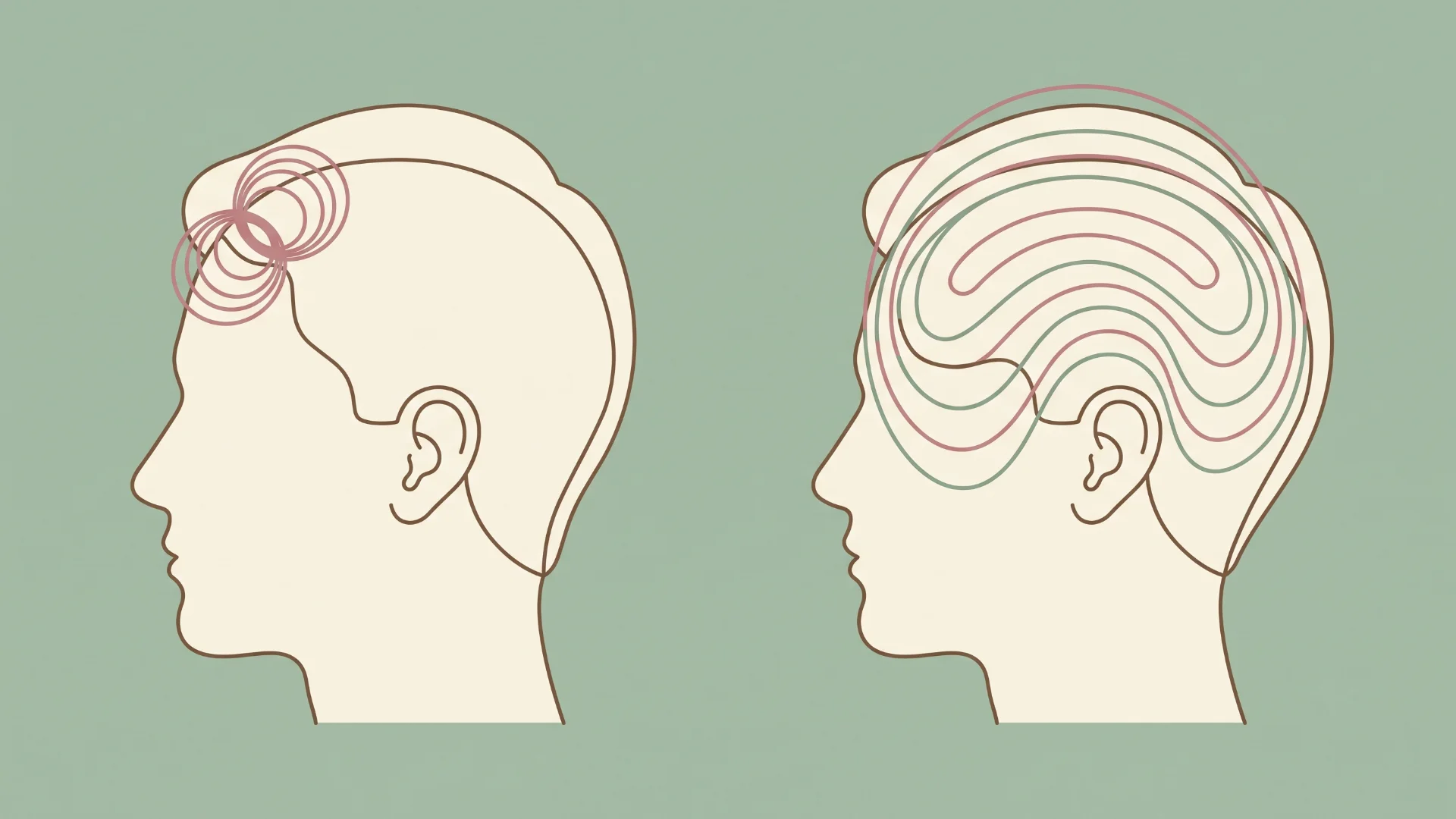
The figure-8 (or "butterfly") coil is two adjacent circular windings carrying current in opposite directions. Where the two loops meet, their fields summate, producing a relatively focal peak of stimulation directly beneath the junction.1 This focality is the figure-8's defining virtue: it concentrates the induced field over a small cortical patch, typically the dorsolateral prefrontal cortex (DLPFC) in depression protocols. The tradeoff is depth. The induced field falls off steeply with distance from the coil, so meaningful stimulation is confined to the superficial 1.5–2 cm of cortex.1 Figure-8 systems, including the device cleared in the original NeuroStar adult MDD pathway, are the standard hardware for 10 Hz left-DLPFC depression treatment.2
The H-coil: broader and deeper
The Hesed (H) coil was engineered by Roth and Zangen specifically to slow that depth falloff. Its complex, non-tangential winding distributes current so that the summed field penetrates farther before decaying, reaching deeper and broader prefrontal volumes than a figure-8 can at a tolerable surface intensity.13 The cost mirrors the figure-8's advantage in reverse: the H-coil is less focal. It recruits a larger cortical territory, which is useful when the therapeutic target is a distributed network rather than a single gyrus, but it sacrifices the pinpoint selectivity of the butterfly design.3
So the core engineering tradeoff is straightforward — focality versus depth. You cannot maximize both with a single coil; the physics of an external field-inducing winding forces a choice.3
What the depression trials show
The pivotal evidence for deep TMS in major depression comes from Levkovitz and colleagues' 2015 multicenter, randomized, sham-controlled trial of the H1 coil for MDD. Across 212 medication-free patients with treatment-resistant depression, active deep TMS produced significantly greater response and remission than sham after the acute phase, and the effect was durable through 16 weeks of maintenance.4 On the strength of that trial, deep TMS with the H1 coil was cleared for adult major depressive disorder.4
Critically, this does not establish that deep TMS is superior to figure-8 TMS for depression. The Levkovitz trial was placebo-controlled, not a head-to-head against a focal coil.4 Reviews of the BrainsWay H-coil platform reach the same measured conclusion: deep TMS is efficacious and well tolerated, but the literature does not show a consistent clinical advantage over conventional figure-8 rTMS for uncomplicated MDD.5 Both coil families clear the same efficacy bar; neither has demonstrated decisive superiority over the other for the average depressed patient.5
When geometry genuinely matters: OCD
The clearest case where coil geometry changes the indication is obsessive-compulsive disorder. OCD is a network disorder implicating the medial prefrontal cortex and anterior cingulate — targets that sit deeper and more medially than the lateral DLPFC depression target.6 Reaching that circuit at therapeutic intensity favors a deep, broad field. The H7 coil, designed for this medial-prefrontal/ACC territory, earned FDA clearance for OCD in 2018 on the basis of a multicenter sham-controlled trial.6 Here, the choice of coil is not a refinement — it is what makes the target accessible. A focal figure-8 placed over the lateral scalp cannot reach the same structures at the same depth. Patients exploring TMS for obsessive-compulsive disorder are therefore in a setting where coil geometry is a primary, not secondary, consideration.
When geometry matters less than people assume
For straightforward major depression, the coil is one variable among several, and arguably not the dominant one. Outcome in DLPFC depression protocols depends heavily on:
- Targeting accuracy — where the coil is placed on the scalp. Functional-connectivity-guided and more anterolateral DLPFC targets have been associated with better antidepressant response.7
- Stimulation intensity — pulses delivered relative to the individual's resting motor threshold, which determines whether the target is actually reaching a therapeutic field.3
- Dose and schedule — pulse count per session, total sessions, and protocol. A standard acute course is roughly 36 sessions over about 6–9 weeks, five days a week, plus a taper.
- Pulse pattern — intermittent theta-burst stimulation (iTBS) delivers an antidepressant effect roughly equivalent to standard 10 Hz rTMS in about one-third of the session time, a difference driven by timing, not coil shape.8
In other words, two clinics using different coils but careful targeting, adequate intensity, and a full dose can both achieve good depression outcomes. Conversely, the best coil aimed at the wrong spot, or under-dosed, will underperform. Coil geometry sets what is physically reachable; the rest of the protocol determines whether the reachable target is treated well.
A device-agnostic bottom line
Neither family is universally "better." The figure-8 coil offers focality and a long depression track record; the H-coil offers depth and breadth that unlock network targets like OCD. Responsible TMS practice matches coil and protocol to the diagnosis and target rather than declaring one geometry superior in the abstract.5 When you evaluate a program, the more informative questions are how the target is localized, what intensity and dose are delivered, and whether the protocol fits your diagnosis — not simply which coil is in the room.
Key takeaways
- Figure-8 coils are focal but shallow; H-coils are deeper and broader but less focal — a physics tradeoff you cannot escape with one coil.3
- For major depression, both coil types are FDA-cleared and effective; no consistent head-to-head superiority has been shown.45
- Deep TMS (H1 coil) for MDD was supported by Levkovitz et al.'s 2015 multicenter sham-controlled trial.4
- Coil geometry matters most when the target is deep or medial — as in OCD, where the H7 coil earned FDA clearance in 2018.6
- For routine depression, targeting, intensity, dose, and pulse pattern (e.g., iTBS) often influence outcome as much as coil choice.8
If you are weighing TMS options across Anaheim and the wider Orange County area, the most useful next step is a clinical conversation about your diagnosis and target rather than a coil brand. You can learn how the treatment course is structured on our TMS therapy page, and confirm what most major commercial payers and Medicare may cover by starting an insurance verification. For deeper or network-based targets like OCD, geometry becomes central — and that is a discussion worth having before any course begins.
Sources / Further reading
Roth Y, Zangen A, Hallett M. A coil design for transcranial magnetic stimulation of deep brain regions. Journal of Clinical Neurophysiology. 2002;19(4):361-370. ↩ ↩ ↩ ↩
U.S. Food and Drug Administration. 510(k) Premarket Notification K061053, Neuronetics NeuroStar TMS Therapy System. Cleared October 2008. ↩
Roth Y, Amir A, Levkovitz Y, Zangen A. Three-dimensional distribution of the electric field induced in the brain by transcranial magnetic stimulation using figure-8 and deep H-coils. Journal of Clinical Neurophysiology. 2007;24(1):31-38. ↩ ↩ ↩ ↩ ↩
Levkovitz Y, Isserles M, Padberg F, et al. Efficacy and safety of deep transcranial magnetic stimulation for major depression: a prospective multicenter randomized controlled trial. World Psychiatry. 2015;14(1):64-73. ↩ ↩ ↩ ↩ ↩
Tendler A, Roth Y, Barnea-Ygael N, Zangen A. How to use the H1 deep transcranial magnetic stimulation coil for conditions other than depression. Journal of Visualized Experiments. 2016;(119):e53801. ↩ ↩ ↩ ↩
Carmi L, Tendler A, Bystritsky A, et al. Efficacy and safety of deep transcranial magnetic stimulation for obsessive-compulsive disorder: a prospective multicenter randomized double-blind placebo-controlled trial. American Journal of Psychiatry. 2019;176(11):931-938. ↩ ↩ ↩
Fox MD, Buckner RL, White MP, Greicius MD, Pascual-Leone A. Efficacy of transcranial magnetic stimulation targets for depression is related to intrinsic functional connectivity with the subgenual cingulate. Biological Psychiatry. 2012;72(7):595-603. ↩
Blumberger DM, Vila-Rodriguez F, Thorpe KE, et al. Effectiveness of theta burst versus high-frequency repetitive transcranial magnetic stimulation in patients with depression (THREE-D): a randomised non-inferiority trial. The Lancet. 2018;391(10131):1683-1692. ↩ ↩